 Upon his return to New York, Pope continued to make illustrated contributions to The Telegrapher. He became the superintendent of the Gold and Stock Reporting Telegraph Co. where he improved and modified an instrument invented by S.S. Laws which reported changes in gold prices to the offices of about 140 New York area brokers.
During the year of 1868, Pope began working on what was to become his most noted literary work. Pope's attempt was to provide a complete handbook for the average American telegrapher and electrician to use in the field and for aspiring students. With great expectations, the first edition of The Modern Practice of the Electric Telegraph was published in May of 1869. It immediately received glowing reviews from both the industry and the general press.

" We know of no other work of the kind so well adapted as this is to all who desire to become intimately acquainted with the wonderful science of the electric telegraph....The New York Herald "
" Your illustrative diagrams are admirable and beautifully executed.....I think all your instructions in the use of the telegraph apparatus judicious and correct, and I most cordially wish you success.....Samuel F.B. Morse "
The first edition sold out in four weeks. As of 1895, it went through fifteen editions and was published in multiple languages. It was adopted as a text book by the United States Signal Service. Pope's clarity of description and the use of his own practical experiences helped readers understand basic principles. In the following excerpt from his book, Pope explains to student telegraphers in 1869, the importance of the time ( spaces ) between the dots and dashes, that when properly combined, create the alphabet and words used in the language of Morse.
" The value of these spaces should be carefully impressed upon the mind of the learner. Beginners are apt to conceive that the Morse alphabet consists solely of dots and dashes, and this misconception has a tendency to greatly increase the time required to become good " senders". Uniformity and accuracy in spacing is of no less importance than in the formation of the letters themselves. The foundation of perfect Morse sending lies in the accurate division of time....."
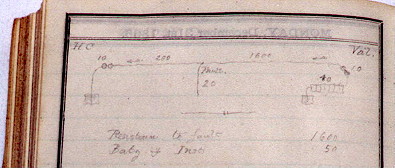
A Telegraph line fault drawing from
Mr. Pope's diary that he carried
during the Russian-American
Telegraph Expedition. He described
this method of locating problems on
a telegraph line in his book.
To Page 6 of 8
Back to first page
